The Sold-Out Sky
What 30 Vendor Conversations Reveal About the Real Bottleneck in AI Infrastructure


Dear Partners,
I recently spent time reviewing transcripts from Data Center World London 2026. Not the keynotes or the panel discussions, but the expo floor conversations. More than thirty vendors across power generation, electrical distribution, cooling, and modular construction, talking candidly about what they can deliver, what they cannot, and what is sold out for years.
What follows is what I think matters for how we think about our holdings and the structural reality of this industry over the next several years.
From Equipment to Electrons
Eighteen months ago, the bottleneck in data center construction was equipment. Transformers carried multi-year lead times. Switchgear was backordered. Cooling systems were difficult to source. That era is ending. Low-voltage switchgear now ships in weeks. Cooling equipment carries lead times that are workable for any serious project. The equipment supply chain has largely normalised.
The constraint has moved. It now sits squarely on power. Reciprocating engines are sold out through 2028. Industrial gas turbines cannot be delivered before late 2030 or early 2031. The bottleneck on the turbine side is precision blade manufacturing, a process that does not scale quickly. Key transformer components carry three to five year lead times. Grid interconnections in constrained markets take twelve months or more before construction even begins.
The table below summarises the current order-to-delivery landscape as I understand it from the vendor conversations.
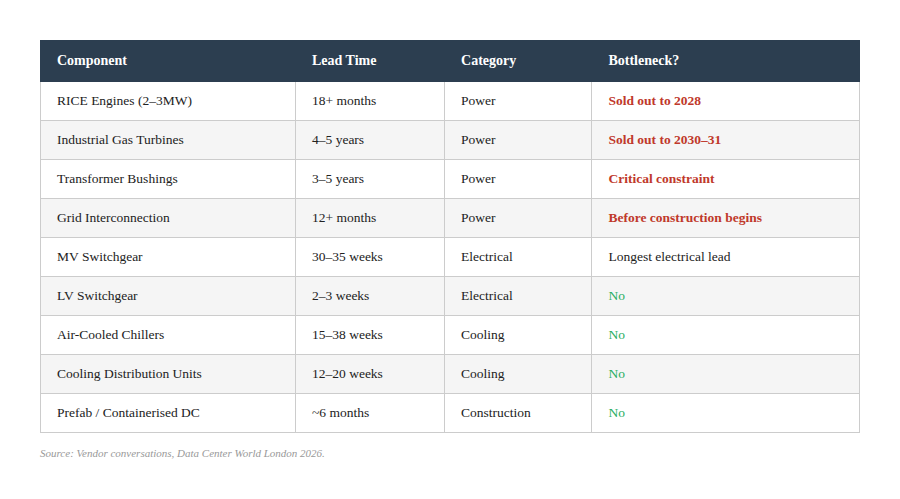
The question that governed data center procurement for the past two years, “can you get the equipment?”, has been replaced by a more fundamental one: “can you get the power?”
The Foundation You Cannot Pour Twice
There is a reason that the most expensive part of any skyscraper is not the steel or the glass. It is the foundation. The piling, the bedrock anchoring, the underground work that no one photographs. It takes the longest, costs the most, and once it is done, it cannot be replicated next door without starting from scratch. Everything visible above ground depends entirely on what was built below it.
Power is the foundation of the data center industry. You can source servers, order cooling, hire electricians, and pour concrete. But without power, none of it computes a single operation. And unlike equipment, power cannot be manufactured on demand. It is tethered to geography, to grid interconnection, to regulatory approval, and to physical generation assets that take years to build.
Companies that already control power, whether through existing grid interconnections, operational generation assets, or binding long-duration contracts with hyperscaler prepayments and parent guarantees, hold something that cannot be replicated on a reasonable timeline. Their advantage is not commercial. It is temporal. They have what others need and cannot quickly obtain. That is a moat measured not in intellectual property or brand loyalty, but in physics and time.
When Speed Costs More Than Steel
One of the more striking patterns in the vendor conversations was how thoroughly speed has displaced price as the dominant procurement criterion. The industry acknowledges that wet cooling systems offer roughly 30 percent lower capital costs and significantly better efficiency than air-cooled alternatives. The economics are not close. And yet, air-cooled systems dominate first-phase deployments because they compress timelines. Developers are choosing the more expensive option deliberately, planning to retrofit later, because delay costs more than inefficiency.
Prefabricated construction tells the same story. Over 90 percent of new builds from one major manufacturer are now prefabricated. Equipment pricing is roughly equivalent to traditional approaches, but containerised delivery compresses what used to be multi-year timelines into months.
When an industry starts optimising for speed over cost, it tells you something about the demand environment. No one rushes to build capacity they are not confident will be used. The urgency itself is the signal.
The Supply Side No One Reads
The financial media covers data centers through the lens of demand. Will the hyperscalers keep spending? Will AI justify the investment? These are reasonable questions. But they miss the supply side almost entirely.
Even if demand were to plateau at current levels, the supply of new capacity would remain constrained for years. Power generation is sold out through the end of the decade. Turbine blades cannot be manufactured faster. Transformer bushings carry multi-year lead times. This is not a story about whether demand will grow. It is a story about what happens when demand has already outrun the physical capacity to supply it.
I often think about what separates good investments from great ones. A good investment is cheap relative to what it earns. A great investment is cheap relative to what it earns, and structurally difficult to compete against. When your advantage is protected by the laws of physics and procurement timelines rather than by a patent or a brand, it tends to be more durable than the market gives it credit for.
That is where I believe our holdings are positioned. Not because we were clever about timing, but because we were disciplined about what we required before deploying capital. Real assets. Sound balance sheets. Operational infrastructure with binding contracts that would take years to replicate. The supply chain data confirms what the thesis anticipated: time is on our side.
The Romans had a tradition when they built an arch. The engineer who designed it was required to stand beneath it when the scaffolding was removed. We apply a version of that test to everything we own. And when I look at the supply chain data from this industry, I see something reassuring. The scaffolding is coming off, and the arches are holding.
Regards,
Neel
Great !